

The market
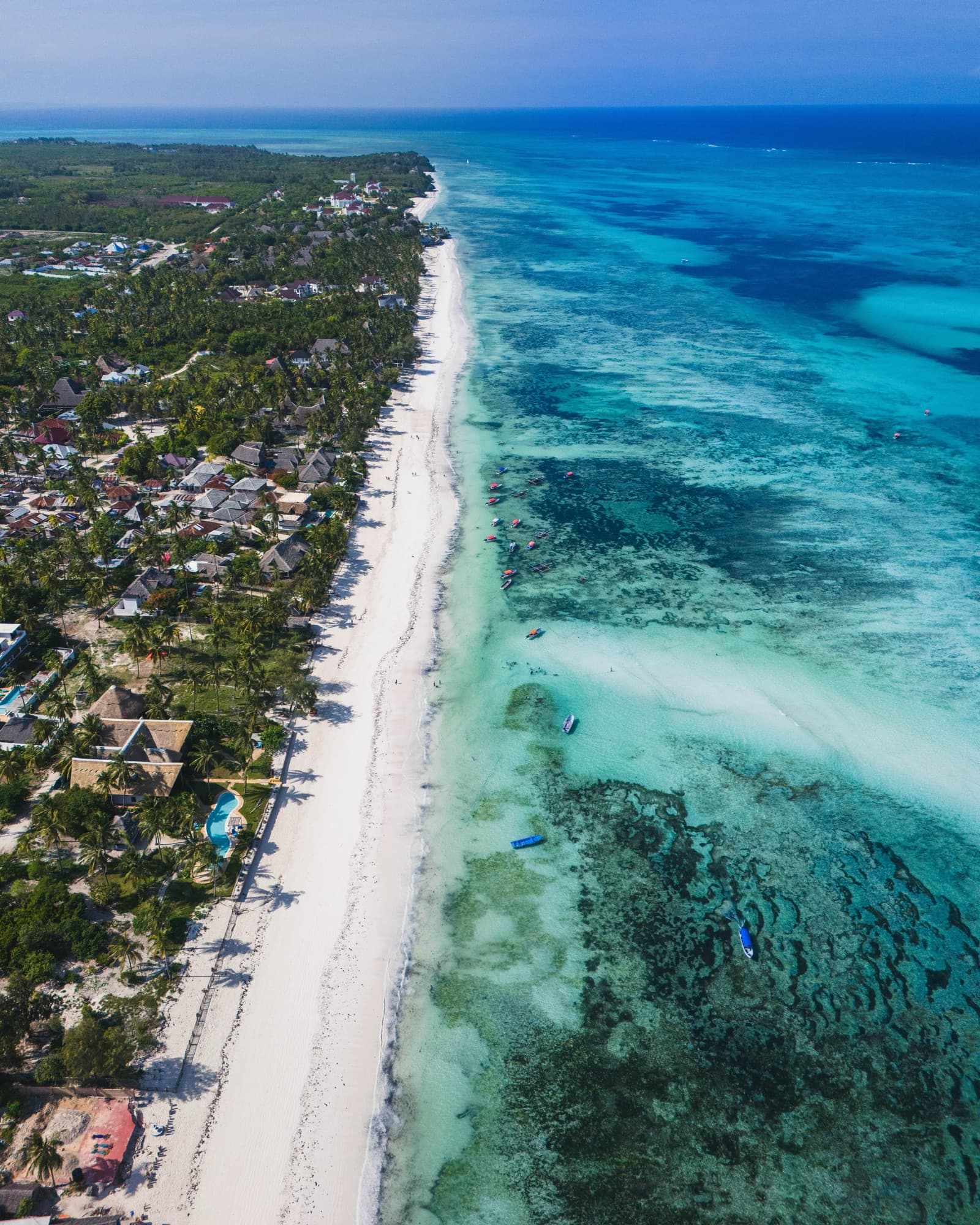
Why Zanzibar, and why now.
Every investment story sounds good on a beach. This one has to hold up on a spreadsheet too — so here is the actual case, followed by the four ways it could go wrong.
Rising
annual visitor arrivals
Tourism is compounding, and beds are behind
Zanzibar has moved from a backpacker stopover to a destination with direct and one-stop connections from Europe, the Gulf and increasingly Asia. Arrivals have grown consistently for a decade outside the pandemic interruption, and the visitor mix has shifted upmarket.
Accommodation supply has not kept pace. That gap between people arriving and quality beds available is not an abstraction — it is precisely what shows up as occupancy and nightly rate, which is to say, as your rental yield.
USD
denominated income
Rents are priced in dollars
Tourist accommodation on the island is quoted, booked and paid in US dollars. For an international investor this removes the single biggest objection to emerging-market property: that your income is denominated in a currency you don't want to hold.
Your exposure is to Zanzibar's tourism economy, not to the Tanzanian shilling. That is a meaningfully different, and more attractive, risk.
~20%
typical off-plan discount
Off-plan is where the margin is
Buying before completion typically means buying well below the price the same unit commands finished. Developers discount early because early capital de-risks their project — that discount is the developer's margin, transferred to whoever is willing to take construction risk.
That is the trade, stated plainly. You accept the possibility of delay and the certainty of waiting; in exchange you enter at a price a later buyer cannot get.
ZIPA
approved developments only
The door is open to foreign capital
Zanzibar has actively courted foreign real estate investment, with a framework administered through the Zanzibar Investment Promotion Authority that allows non-citizens to hold property in approved developments, and links qualifying investment to residence permits.
We buy only inside that framework, and only where title and approvals check out. If a development cannot evidence its status, we do not list it — regardless of how good the numbers look.

The other half of it
And yes — it’s also just a beautiful place to own something.
We could pretend this is a purely financial decision. It usually isn’t, and there’s nothing wrong with that. There is a particular feeling in knowing that a building on an island in the Indian Ocean has your name attached to a piece of it — that when the sun goes down over Nungwi, some fraction of what that view is worth is yours.
Most people file that under “one day”. The only reason it stays there is the price of the first step. We made the first step $1,000.
Own the dream, but underwrite it like an investment. Both things can be true.
The honest part
Four ways this could go wrong.
We would rather you understand these now than discover them in year three.
Construction risk
Off-plan units can be delivered late, or in rare cases not at all. We mitigate with milestone-linked payments and developers with a completed track record, but we cannot eliminate it.
Concentration risk
One island, one economy, one sector. A shock to Zanzibar tourism — weather, health, security, aviation — hits every property in the portfolio at once. This should be one holding among many, not your plan.
Liquidity risk
There is no established secondary market for participations. Assume your capital is locked until the unit is sold, and invest only what you can leave alone for that long.
Regulatory & title risk
Foreign ownership frameworks are policy, and policy can change. Title verification in any emerging market requires more care than in a mature one. We do the work, and we still tell you the risk exists.
Capital at risk. Projected returns are estimates based on stated assumptions, not guarantees. Off-plan property carries construction, developer, currency and liquidity risk. Past performance does not predict future results. Read the full risk disclosure before investing.